Explore Spain:

Useful Resources:

RSS:


Site search

Our Projects...


Recent Comments

Recent Posts

Archives

Archive for 'Spanish Food and Drink'

The Humble Sandwich Mixto

Sandwich Mixto

This post is inspired by the extraordinary discovery that the above photo, of the simple Sandwich Mixto, is the most viewed image in my Flickr Stream.

So here’s the question: You walk into a Spanish bar wanting a quick, satisfying, base food fix, something more that than the free tapa that comes with your beer. Maybe it’s eleven o’clock and you need a calorie boost, or something to take the edge off your hangover. What’s it to be?

Mine’s a Sandwich Mixto, two grilled slices of slightly oily toast, with cheap ham and cheese in the middle. The Spanish equivalent of a bacon butty. Can’t beat it. What would you order in similar circumstances?

Updates: On the coast this is often called a ‘Bikini’ - see comments. Plus, Chris from Spanish Sauce has the full Sandwich Mixto / Bikini recipe here!

Jamon Serrano and Jamon Iberico - What’s the difference?

Vacuum-packed Jamon Iberico

Photo: Vacuum-Packed Jamon Iberico - the single greatest souvenir a returning Spain-traveler can bestow on their loved ones.

Jamon Serrano:

- Doesn’t generally taste as good as Jamon Iberico.
- Is likely to choke you to death if you don’t cut it up into small pieces before putting it into your bocadillo (bread roll). I don’t want to go into details but beleive me, if you start swallowing half a 10 inch strip while still chewing the rest… scary… Spanish parents always chop Jamon Serrano up small for their kids for this very reason.
- Is usually machine-sliced and is more likely to be found in cheap bocadillos (which are therefore more likely to choke you!)

Jamon Iberico:

- Tastes so much better… alone, with morsels of bread, even with “is-this-nirvana?” jamon, egg and chips.
- Tends to be cut by hand, sliced thinner and in smaller sized pieces, and therefore:
- Is less likely to choke you when:
- Found in more expensive bocadillos.

These are fairly random observations (from someone who recently nearly choked to death on a cheap, train-buffet Jamon Serrano sandwich). But what is the actual physical difference between the two types of ham? I suspect there is an Iberico ham pig and a less refined Serrano ham pig. But within the Iberico pig category there are those with black feet (Pata negra), and others that are only fed on acorns (bellotas) for the last year of their life.

I know that eating pata negra, bellota-fed jamon iberico makes you feel somehow closer to heaven, but if anyone can help clear up the exact differences between Jamon Iberico and Jamon Serrano, I’d be very grateful! Answers/thoughts in the comments please!

Is Spanish Food Oily? Say Hello to the Plato Alpujarreño

Plato Alpujarreño

There was a healthly (?) discussion on the forum recently about whether or not Spanish food is oily. Quote: “the amount of oil most dishes are served with is mind boggling.” The basic consensus though, was that Spanish food is essentially oily in a good way. I mean, you can’t get enough of that anti-oxidising, extra-vigin, life-restoring olive oil, can you?

Well, my friends, I fear that some may draw the line at the Plato Alpujarreño.

Pictured above, and served up throughout the wonderful mountain range to the south of Granada, this cacophony of meat and not-very-extra-virgin grease slips down a treat. From the top we’ve got Jamon, Chorizo, Morcilla (no rice in this one, just the congealed pigs blood), a good slab of pork chop, the fried egg and, the coup de grasa, the oiliest of all oily potatoes: patatas a lo pobre.

Absolutely spot on after a day in the mountains 8) Would you eat it?

A blog post in a comment: Spanish, Tact, and Food

I just noticed the following comment appear on my previous post and thought it was such an extremely accurate and acute observation that it deserved not to be missed. It speaks volumes of the Spanish attitude to both sincerity and their fine national cuisine:

“Fact: If you cook dinner for Spanish friends, they have no problem giving you a detailed critique of the meal when it is finished.

I remember noticing this on the Spanish cooking show, Hoy Cocinas Tú, in which a person learns how to cook a dish and then makes it for family/friends. The dinner guests always offer suggestions as to how the dish could have been improved. I have grown accustomed to this and now I prefer a fair assessment of my food to an insincere compliment.

I usually only prepare foreign dishes for Spanish friends (American or Mexican fare) so that they don’t really know what the dish is supposed to taste like. And yes, I leave out the hot spices. Something that defeats the purpose of many Mexican dishes.

One more thing, you cannot change a single ingredient when making a standard Spanish dish or you will never hear the end of it. I made a tortilla the other night for my girlfriend and her mother. They both looked on in horror as I made it with cheese and onions—something that just isn’t done here. It was as if I were mixing two highly volatile chemicals like bleach and ammonia. The only way I could get them to try it was to convince them that it was a French dish.”

For more of the same, check out the author’s blog at www.leftbanker.com

Be Spanish - Drink Cava for Christmas!

In today’s guest post, Spanish wine expert Ryan Opaz from Catavino.net says go with the Champagne from Spain!

So often, when we think of the holidays, our thoughts immediately turn to Champagne. Living in Spain, Spaniards also tend to follow the same train of thought, and in truth, it’s just plain sad. Cava is to Spain what Champagne is to France, typically of equal quality and always at a lower price. While the most expensive Champagnes will push 200 or more euros a bottle, you’d be hard pressed to find a Cava over the 50 Euro mark in Spain, and I swear to you, the quality is often times just as good.

Frexeinet is the largest producer of Cava in the world making a wide range of wines and styles. Often known as the “black bottle Cava”, their trademark black bottle is a perennial favorite party wine, affordable and well made. This year, in an effort to market their wines to a broader audience, they’ve commissioned Martin Scorsese to create a short film about one of their other value wines, Carta Nevada Reserva.

The Key to Reserva is a short, simple, yet entertaining, 10 min film in the style of Alfred Hitchcock. I’m not sure if it will sell any Cava, but at the least we all now have something to kill another 10 minutes worth of time with!

Tasting Note:
Carta Nevada Non-Vintage Reserva
Relatively large bubbles as compared to other cavas with a nice light golden color overall. The nose has a a light toasted quality with some almond aromas, pineapple and lemon zest. In the mouth, the wine is fully dry with a softness that leaves a refreshing feeling on the finish. Not a strong wine, delicate flavors of lemon, melon, toast and minerals. Good value for a large gathering. Pair this wine with a variety of lighter dishes. Personally some Gambas a la plancha would be my ideal choice!

Ryan’s blog Catavino.net covers the wines of Spain and Portugal. This December is dedicated to Cava, so check them out for more information.

Happiness is… a “tube” of Spanish beer and Tapas

Tapas and beer!

Spanish beer is served up in a huge variety of shapes and sizes, but nothing beats the good old fashioned tubo pictured above… Though the tapas in the picture usually provoke a collective groan from my friends and I - there’s just something too pink about this particular brand of embutido (I’ll even take bog-standard olives over this stuff!)

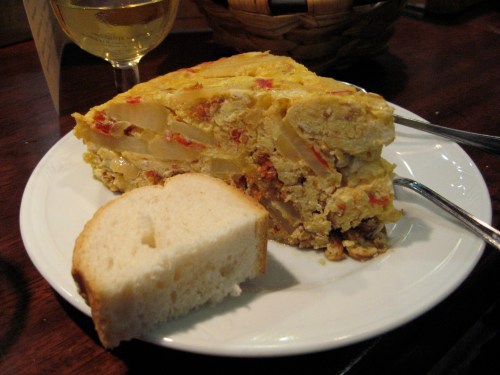
At the other end of the tapas scale you have this, Tortilla Paisana, the mother of all omelettes!

Tapas and beer!

OK, so the tapas in the first picture are free, and you always have to pay for tortilla this magnificent, but Tortilla Paisana is worth a every centimo. Look at it! It’s a meal in itself! What distinguishes the Tortilla Paisana from your average slab of potato and eggs? Apart from it’s size, it usually includes other delectable ingredients such as chorizo, red peppers, even peas!

Commonly found in Asturian bars and restaurants, where food is always large!

Son of a nice fishy tapas… and nepotism in Spain

Japuta tapa

Hijo de puta (son of a ‘prostitute’), is up there with the worst swear words in Spanish. It’s even worse than the ‘C’ word, which is actually bandied about freely in bars, at more relaxed dinner tables, and on television. So I was quite surprised to find a tapas called ‘Japuta‘, pictured above, that is blatantly a shortened version of Spain’s most violent phrase.

Japuta itself is basically a white fish, served here fried in a herby batter. We ate it in Cordoba, and it comes highly recommended even by someone not too keen on fish: me.

Anyway, this reminded me once more of a conversation I had with my sister-in-law about my own sister, when she had just got a great job as a reporter at Reuters in London, purely on her own merits (mentioned in a previous post on the enchufe). My sister-in-law said ‘That job in Spain would only be for el hijo de‘ - for the son of… not meaning ‘hijo de puta‘, but rather that any job that good in Spain only goes to people with connections. ‘The son of’ someone important gets a better job. I’m sure this is true, but what I wonder is, how much does this still go on in places like the UK, where everyone is so sure that the stain of nepotism was removed from society years ago?

Jamon Iberico, Egg and Chips - Heaven!

Jamon egg and chips!

This might like look like another Spanglish culinary mash-up, but beleive me, there is no shame in ordering a plate of Jamon Iberico, egg and chips on your travels around Spain. In fact, sumptuously salty ham, sticky egg yolk, and plump chips fried in olive oil go so well together that you might very well ask why, with this on a menu, you would ever order anything else! On a recent trip to Malaga we became so enamoured by this dish that my father and I ate it two nights in a row, washed down with a nice glass or two of vino blanco.

When we returned to the city a week later we headed straight for the same meal, discovered that the restaurant that served it had Sunday nights off, and spent the rest of the evening feeling mildly depressed (well, until we decided to go and have supper in the Parador instead ;) )

More on Malaga, Paradores, and our trip down south, soon…

Tocino Iberico - Tapas of the week

tocino iberico

Forget tapas of the week, this could be tapas of the year!

How to describe tocino? The dictionary says ‘fat’, but that is like describing caviar simply as ‘fish eggs’. Let’s see, you know the white around the edge of ham that your mum always tried to persuade you was the best bit when you were young? It’s the same stuff, and guess what, it turns out she was right.

Tocino Iberico, however, the delicate fat that warms the flanks of Iberian pigs as they forage for acorns in cork forests, is in a league of its own. The photo above was taken in the wonderful Cumbres Mayores tapas bar in Cadiz, where these inconceivably thin slices of tocino, streaked with a fissure of ham, were warmed slightly in the oven and served on curled up bread sticks. The tocino literally melted on the tounge, a smokey, acorney, subtle delight. Forget the fish eggs, you can give me pig fat like this any day of the week.

Would you eat the white around this ham?

Tapas of the week: Motadito de Jamon Iberico

Motado de Jamon

Motados, often called by the diminutive term Montaditos, are a mini-meal in themselves. Take a palm-sized baguette and insert almost any tasty morsel you can imagine - from squid to tortilla, pork fillet to slices of Manchego cheese - and that’s it, the perfect snack! The photo above shows my personal favourite, the elite, the unbeatable montadito de jamon iberico: several slices of Spain’s finest Iberian ham lovingly clasped in slightly warmed bread. And what better accompaniment than a glass of Andalusia’s finest Cruzcampo beer? Heaven.

What would you put in your dream montadito?