Archive for the ‘Living in Spain’ Category

Community – Do you live in one?

16 comments

Forget online communities for a moment, do you have a real, live one on your doorstep?

In Spain the collection of neighbours in a flat block is called a ‘comunidad’? But I wander what that means?

In our case it means saying hello to everyone, chatting to the occasional neighbour, feeling safe about the other people in the building. But there isn’t much ‘popping round for tea’, or ‘could you look after the kids for a minute while I nip out for (fill in the emergency)’.

Part of that is our fault. If our lovely English neighbour at the end of the corridor is reading this, then a million apologies for not having you all round for that cake yet – we will soon, as soon as a weekend looks like a weekend!

But I suspect that in big cities people don’t just pop in and out of each other’s houses any more for a cup of tea, or look after each others’ kids at the drop of a hat – like they did in the old days, didn’t they?

Do you live in that kind of real, close-knit, sociable community? Does it exist any more? Can it exist in big cities? We’d love to live it better, but wonder if that world still exists these days, or if people just don’t have time any more…

I’d love to hear your thoughts, whether you live in Spain, Ireland, Australia, or Timbuktu!

Written by Ben Curtis

March 8th, 2010 at 5:31 pm

Posted in Living in Spain

Accustomed vs Resigned

29 comments

Conversation I had with a smart Argentinian guy in a suit outside a bookshop yesterday. Time Bookshop was meant to open, 5pm. Bookshop still shut at 5.10pm:

Argentinian guy: That’s why this country is in such a mess.

Me: It drives you a bit mad. The other day I went to the bank, it was meant to open at 9.30, didn’t open til 9.45! A bank!

Argentinian: See what I mean?

Me: In the end you get accustomed to it.

Argentian: No, In the end you resign yourself to it…

I wanted to tell him to lighten up. There is a big difference between getting accustomed to something, and resigning yourself to it, and I think I prefer the former.

In fact I think I’ll redo my Expat manifesto, to add the following:

7. When living somewhere you don’t originally come from, don’t resign yourself to the differences, just smile and get accustomed to them.

[Note: Please don't use this post as an excuse to leave negative comments about Spain - they will be deleted! I've had enough trouble with that in the past!]

Written by Ben Curtis

February 18th, 2010 at 9:49 am

Posted in Living in Spain

Damn, still not Spanish enough!

24 comments

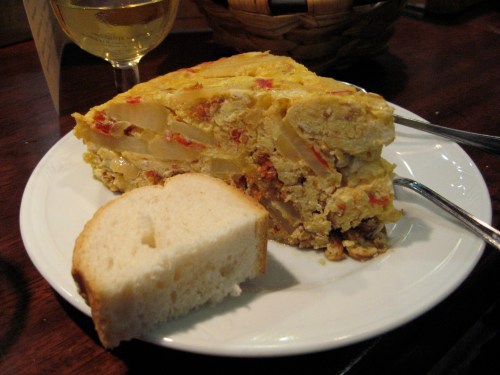
Spanish Tortilla Tapas

I just popped out to a favourite local bar, where my favourite barman, super-friendly, 50-ish, thick white hair and humour as dry as a brick, brings in his home-made tortilla every day.

Un pincho de tortilla’, I said, ‘but don’t heat it up, I’ll have it just as it is’.

I’m not fond of microwaved tortilla, so usually add this specific request.

‘Si si,’ he replied, followed by some incomprehensible mumbles, and two minutes later, I was presented with an enormous slab of steaming microwaved Tortilla.

Damn. At this point it dawns on me that the mumbles I’d missed in his earlier reply must have been something like ‘Si si,…but you can’t eat it cold, it’s much better heated up.’ Subtext: you don’t know what’s good for you, I’ll bring you your tortilla how you really want it, piping reheated-hot!

Now, if I was Spanish enough, I would a) have complained at this point and demanded what I’d asked for, namely cold tortilla, and I suppose b) understood what he’d mumbled in the first place! I like to convince myself that after 11 years I’m pretty much 99% bilingual in terms of understanding spoken Spanish, but this guy’s mumbles cause me no end of trouble!

The real issue here though, is the incredibly well-intentioned ‘you don’t know what’s good for you’ subtext that led to the hot tortilla (which was very nice in the end, of course). It happened earlier in the year when I was in the same bar with my father.

Dad wanted a ham and cheese bocata (roll). ‘Una bocata de jamon iberico con queso manchego’, I asked my white-haired mumbling barman friend.

‘Ha, yeah, right!’ he answered, with a look of wry disbelief on his face, ‘Jamon iberico and cheese in the same peice of bread? Are you mad? Jamon York and cheese yes, but certainly not Iberico! There are some things you just don’t do!’

‘Errr, a jamon iberico bocata and a seperate plate of manchego cheese then?’ I ventured nervously…

Asi es, now you’re talking,’ he smiled, and that, of course, is what we ended up with.

The universe could rest in peace, things had been restored to how they should be. Iberian ham and manchego cheese together, yet separate, como Dios manda.

If I was just a little bit more Spanish after all these years of concerted effort, I would have know that in the first place!

Oh well, maybe after another 11 years…

Written by Ben Curtis

February 9th, 2010 at 11:48 am

Earning the Right to Complain

22 comments

Yesterday I linked to an article in the Telegraph by a young woman who didn’t like all the smoke she had to put up with while pregnant in Spain. The article mirrored sentiments of my own and, importantly, those of my wife Marina when she was pregnant here in Madrid.

What I found shocking, was the ferocity of the comments left on the Telegraph website, after the above-mentioned article (they were almost Daily Mail bad!) Most were along the lines of ’stop complaining – if you don’t like it, leave Madrid – it’s not your country, so deal with it’.

But here’s the point. If the expat who wrote the article complains about the smoking in Madrid, she is lambasted as a moaning foreigner with no right to do so… no matter how long she’s been here…

If Marina, a Spaniard, moans about exactly the same thing, no-one would doubt that it’s her right to do so.

So the question is, how long do you have to live somewhere, be it Madrid, Sydney, or Bangkok, before you really do form part of the framework of your new home country, before you really can call it your own, and thus have the right to make the exact same complaints as the locals?

Just thinking out loud, but it’s a tricky one…

Written by Ben Curtis

December 15th, 2009 at 1:22 pm

Posted in Living in Spain

The Bilingual Battle and Leaving Madrid – Notes from Spain Podcast 75

31 comments

Audio clip: Adobe Flash Player (version 9 or above) is required to play this audio clip. Download the latest version here. You also need to have JavaScript enabled in your browser.

[Download MP3]

Ben and Marina record a new podcast about the battle for our baby’s language skills, why we want to leave Madrid, the trouble with summer in Madrid, and baby timetables in Spain.

Comments welcome!

Written by Ben Curtis

October 10th, 2009 at 8:52 pm

When not to call your Spanish wife a whore….

30 comments

In a survey I recently took about being an expat in Spain, I was asked whether I had every ‘put my foot in it’ culturally or linguisticly since arriving 11 years ago… and one experience came straight to mind.

A few years ago Marina and her sister were swimming in their parents’ pool up in the sierra beyond Madrid. As I sat on the edge lazing around, Marina’s sister swam up behind Marina and, as one does in swimming pools, playfully ducked Marina’s head under water.

Marina emerged seconds later with a wild exclamation of: “ZORRA!

Zorra (noun) = female fox, or (slang) whore

Zorra Tu“, shouted Marina in return, and they both splashed about laughing.

Now there’s an inventive use of the language I thought, one for the databanks, can’t wait for an opportunity to try it out myself!

The next day, back at the poolside, two of Marina’s oldest friends, a married couple, came round for tea. Pool antics ensued, and when Marina pushed me from the side into the water, I seized my chance to try out my favourite new word:

Zorrrrrrrrrraaaaa!” I cried in delight, when I resurfaced….

” – - – “, replied Marina, a mute expression of total disgusted horror on her face.

Later, long after they had left, and Marina still hadn’t spoken to me for about 5 hours, in desperation I managed to corner her in the kitchen for the following enlightening conversation:

Ben: “What the hell is wrong?”

Marina: “Are you stupid or what?”

Ben: “Clearly, because I haven’t got a bloody clue what’s wrong with you!”

Marina: “Don’t be so ridiculous, I can’t believe you don’t know why I’m so pissed off…”

Ben (pausing for divine inspiration): “Ummmmmm… Nope.”

Marina: “YOU CALLED ME A WHORE IN FRONT OF MY FRIENDS, IDIOT.”

Ben (wracking brains for proof this might be true): “Um, are you sure?”

Marina: “You called me a Zorra when I pushed you in the pool!”

Ben: “Oh yes that, ha ha, I’d been waiting to use that for ages!”

Marina: “…eres un gilipollas, vamos…” (=You stupid d*ickhead)

Ben: “But… but you and your sister said the same thing to each other in the pool just the day before!”

Marina: “THAT’S DIFFERENT!”

Ben: “???”

And so another part of my Spanish education was complete. Your wife may call her sister a whore in front of you, and her sister may equally be-whore her in return, and it’s all good fun!

But woe betide you if you dare to presume to learn by mimicry. What works for one person in situation A, is by no means available to you in the similar, but almost-inappreciably-different, situation B.

I tried to explain this to Marina of course, that I was just a victim of the ‘witness, commit to memory, try it out soon’ school of language learning, but sadly she was still slow to forgive. Took about four years if I remember correctly before the whole event was truly forgiven (but not forgotten).

So be warned! A Spanish woman may be a zorra in front of her sister, but never in front of her friends.

Written by Ben Curtis

August 26th, 2009 at 7:48 pm

Posted in Living in Spain

The Worst Thing That Can Happen To You In Spain

39 comments

You live happily in your big old flat block in the middle of Madrid for 5 years without so much as a hiccup, then all of a sudden, one day your sister-in-law overhears a bit of gossip in the building lobby that changes your life forever… something so serious that you have to pretty much immediately start looking for a new place to live… an utterly compelling reason to leave your dear, sweet home forever… without so much as a backward glance…

Not cockroaches in the bathroom, noisy neighbours, burst water pipes, or a dial-up internet connection (none of which we suffer, thank god) could be worse than this…

The catastrophic conversation overheard by my sister-in-law on the way up to our flat just minutes ago, between our porter and an elderly resident, went like this:

Old guy: “So, the new Presidenta is Marina Diez?”

Porter:”Yes, it’s just been decided in the residents meeting…” [that we avoid like the plague]

Old guy: “The girl with the baby…”

Porter: “Yes, that’s the one.”

Yes, my wife Marina has apparently been made Presidenta de la Comunidad… Marina, ‘the girl with the baby’… and the business to run… and no time to so much as stop once a day for a glass of gazpacho… handed the worst thing that can happen to you in Spain…

… the sooner we get out of here the better… our very sanity, and with it our health, is at stake. Marina has been landed with the one job no-one here in planet-Spain would beg for in a million years.

Let me explain:

The ‘comunidad‘ is the collection of people that live in this building. In our case, Marina has been nominated boss of said ‘community’ for a year and will be required to take on associated administative responsibilities.

Doesn’t sound too bad, does it? And after all, the post is changed once a year by a fair system of rotation (apparently) – everyone gets a go.

But let’s look at the facts. There are ONE HUNDRED flats in our building. The above-mentioned “collection of ordinary people” that live in them is HUGE, mostly elderly and bored, and often somewhat mad.

And when they find out who has been nominated, albeit by this fair rotational system, to be in charge of them for the coming year, they will become psychotic, oppressed, moaning whingers, who’ll be beating down our door on a daily, no, an Hourly basis with the most inane building, neighbour, lost cat, cracked basin, just-a-bit-lonely/bored and god-knows-what-else related complaints they can possibly come up with, whenever they can possibly think of an excuse to come up with them!

That’s not even considering all the trips to the bank, document signings etc Marina will have to take on and, worst of all, worse than having all these people coming to our door for a year… Marina will have to chair the dreaded “residents’ meetings”… where the great unheard flat-owning masses of our dear community are all put in one room to rant, rage and olympicly moan at the same time!

We await official confirmation… with a gathering sense of dread. If it’s true, which seems 99.99% certain, then there is only one allowable way out. To leave the building, better still, to leave town. We’ll be heading for the hills. Flat (maybe) for rent. Watch … this … space…

Written by Ben Curtis

June 2nd, 2009 at 9:32 pm

My Secret Spain – Guest Blogger Maureen Dolan

9 comments

Guest blogger Maureen Dolan asks what you do when the romance of Spain wears off?

You’ve been here a decade and find yourself living in just another country, one sometimes less progressive than your own. You were drawn here by los toros, el sol, el flamenco and la siesta. Now you defend animal rights and prevent skin cancer. Your work ethic baulks at lying about in the middle of the day and Camarón triggers your migraine. Maybe you should “go back”.

But you can’t – you have a wife or husband and kids. And the sentimiento trágico de la vida sets in.

It happens to me. But I have a secret. Her name is Última. I found her in 1983, in the novel Bless Me, Última by Rudolfo Anaya, set in 1940s wartime North America.

Far from being last, as her name suggests, she was my first, connecting me, not only to a new culture, but to a new idea of culture. I knew about Spain’s South American colonies, but this was new, as it knotted my English-speaking life and my love of Spanish together in a new way.

In the mid-eighteenth century an expansionist United States invaded Mexico, finally ending a brutal war only when half of Mexico was ceded to them for $15,000. California, Arizona, Colorado and what is now New Mexico – names given them by the Spaniards – joined the U.S. But what about the people? They were given a choice – stay or go. Most stayed on their ancestral lands.

Bless Me, Última, published in 1972, introduced me to the New Mexican descendants of this land grab. The Spaniards (unlike other conquerors of the Americas) left their families at home and had offspring with the native population, resulting in a mestizo Spanish European and American indigenous race. Última’s people are Spanish-speaking vaqueros and farmers whose religious beliefs blend Spanish Roman Catholicism and Native American animism. Their horsemanship is Spanish and their speech contains archaisms from sixteenth-century Spanish.

Última, an elderly curandera, was so named to underline how the agrarian lifestyle of the Luna farmers and Márez cowboys is fated to disappear. The young people are schooled in English and seek urban jobs or join the army. The novel is written in English, although Anaya, a Spanish-speaker, not only reflects the underlying Spanish speech patterns but inserts many borrowings from Spanish (a strategy now used by non-Hispanic writers, such as Cormac McCarthy).

Yet, in the 1970s people of Hispanic origin clamoured for cultural survival and social equality. They carried out mass protests, adopting the strategies of the Black Civil Rights Movement. Their principal battle was to defend, not one or the other aspect of the Anglo-Hispanic environment in which they lived, but their bilingual, bicultural way of life.

One of the fundamental pillars of this movement, called the Chicano Movement, was the demand for bilingual education. Children born into Spanish-speaking homes and then schooled in English often became high-school dropouts as they were expected to acquire knowledge before they were well-grounded in the new language. The Chicanos, their numbers swelled by waves of Mexican immigrants to the U.S., won the battle which all other linguistic minorities in the United States lost – they retained their Spanish language while adopting the Anglo-Americans’ English, through bilingual education.

In the United States, throughout most of the 20th century, Spanish was regarded as a “poor people’s” language. Today, however, non-Hispanic North Americans are learning it in droves, due to the upward mobility of Hispanics and the Spanish transition to democracy after Franco. Politicians of every stripe, Barack Obama the latest example, court the Hispanic vote in Spanish. The Instituto Cervantes is gearing up to corner this huge cultural and linguistic market. It has centres in New York, Chicago and Albuquerque and centres are planned for San Francisco, Houston and Washington D.C.

And so, Última was not the last, but the first, as the wisdom of her hybrid culture, with what I like to call the struggle between the roots and the road. Far from disappearing, it has transformed itself and endured.

Today mainstream America emulates her ecological respect for the land and her embodiment of the “sacred feminine” so revered now by Goddess Feminists. With Última, I began to learn that nation state borders are arbitrary, that cultures have no boundaries and that there are no dividing lines on the land. Languages meet and blend, Spanglish being just one example. Politically, culturally and philosophically, nothing is static or monolithic. And while you can´t always move away, move back, move up, you must always move forward.

So forget romance. Forget tragedy, and move forward, with Spain.

Do check out Maureen’s blog for more inspiring writing, at www.cecyspain.blogspot.com

Written by Maureen Dolan

April 27th, 2009 at 7:51 am

Bowl of the Scarlet Oak – Guest Blogger Simon Beckmann

5 comments

Guest Blogger Simon Beckmann is setting up something wonderful in this, his most secret corner of Spain…

I step from the door and look aloft to the azure sky expecting to see the white scratch of the sun seeker’s jet stream, reaching from the north, moving south.

But not here, here the sky is clear celestial blue, and high in a rising kettle, I count seventy six vultures, tea trays in the sky blown upward in a levant. And beneath this tower of griffons pass a pair of golden eagles preparing to quarter the forested hillside, a surprise offensive against breakfast.

Our home, our secret Spain, is a cortijada, Cortijada Los Gazquez, a collection of small cortijos folded across a mound in the Hoya de Carrascal, the bowl of ‘scarlet oaks’.

These oak, Quercus coccifera, or kermes oak, were historically important as the food plant of the kermes beetle from which a cochineal type of red dye was produced. Kermes is the origin of crimson. It is more of a prostrate shrub than a tree, it’s leaves akin to the leaves of a holly, it’s acorns sitting in a spiny cup. It is evergreen and perfectly exploits the limy soil forming thickets called chaparrals.

Within these chaparrals on the edge of the barranca springtime brings a tribe of yellow bee orchids to flower. Ophrys lutea clearly displaying it’s mimicry of a bee abdomen on it’s extended lebellum, drawing unsuspecting andrena bees to fertilise a flower, not a fellow bee.

Here too we have seen three ibex, strangely unperturbed by our presence, and wild boar, the progenitor of our domestic pig, concealing their preponderance behind mauve and white florescences of rosemary.

The cortijada lies in the centre of the Parque Natural Sierra Maria-Los Velez in the top right-hand corner of Almeria. It is a primal place of semi-wilderness and long abandoned farm houses. Life, as it was in this alpine desert, was hard and fleet footed farmers moved to France years ago, never to return to the campo. Fifty years later time and the cortijada have changed.

Los Gazquez, today the power of the sun and the wind provides hot water and light within. Wood fires of almond, olive, poplar and pine, centrally heat the floors on cold winter evenings. Routine is to carefully stack the kitchen wood pile with chopped almond in preparation for cooking supper on our Spanish range.

Rainfall is collected from the roof in a series of acequias directing water to the aljibe for storage and provides the house with all it’s domestic needs. A series of reed beds cleanses waste water, and grey water from the showers and basins is filtered and used to irrigate the orchard terraces.

And today we make the final touches to the grey water system. We have prepared three south facing terraces, away from the north westerly wind. Their walls built from dry stone from the fields. On each I mark a corridor with string running the length of the terrace, as wide as I am long. This area I turn with a fork and rake smooth.

And here we plant a pear, kaki, fig, apricot and more, making wide circular depressions around their bases which are filled with wood bark to mulch the trees. On either side of the corridor I leave the profusion of wild flowers that sing with insect life, poppies and tangier peas, pheasant’s eye and tassel hyacinth.

Next I make clay from the soil and fashion a small canal. When it is dry, baked by the sun, the grey water from the household is directed to the base of each of the saplings. Our grey water contains only ecologically sound detergents so it will not damage the tree nor taint the flavour of the fruit.

Like every other member of mankind I am not a figure in a landscape but a shaper of the landscape. I manipulate land and life form to suit my needs.

As an artist I have made this project fulfil my aesthetic needs as well as my practical needs, I am an explorer of nature who has made his home in this wonderful place. And when I look aloft to the golden eagle in the sky at the apex of the food chain, I take great sustenance from having fulfilled a project which aimed to exist benignly on this land, and that our being here will no more effect the natural ecology other than to serve it.

Simon Beckmann can be found at www.losgazquez.com, please check out this wonderful project!

Written by Simon Beckmann

April 22nd, 2009 at 7:00 am

The Other Side Of Easter in Cadiz… – Guest Blogger Robert Gordon

13 comments

Guest blogger Robert Gordon reflects on the recent Easter migration to his corner of the Bay of Cadiz…

Benidorm

Just over 10 years ago the area in which I live was covered in woods and fruit orchards, indeed my own home is set on what was an orange grove – as you can see from the photo many changes have taken place. The development of this part of La Bahía de Cádiz has established it as a considerable attraction for Spanish tourism, indeed over ninety per cent of the visitors here are Spanish, most of whom are second home owners.

In my barrio, the Spanish swallows arrive from Sevilla, Cuidad Real, San Sebastian and mostly from Madrid. What brings them to a fairly ordinary town to pass their well earned holidays, and how do they pass their time?

Well in most part they come for the ambience. Los Gaditanos have a reputation: “Ellos saben reírse de sí mismo” (they know how to laugh at themselves) even in these difficult times. During fiestas they form sizable groups in the cork woods, break into song, and will adapt any handy object into a form of percussion to enjoy day long festivals created by their own initiatives and paid for by their “vaquita” (piggy bank).

Many of the city dwellers that arrive have told me they seek “turismo nacional” and it can be found here in a form much less “bomdardeado” than in many other parts of coastal Spain. They are “con su gente, como estar en casa” (with their own people, they feel at home).

Semana Santa, Easter, represents “un aperitivo del turismo” with the main course served in July/August. Alongside the week long religious festival, the visitors relax, recharge batteries, and enjoy the local attractions which are mainly the food, spectacular light, and the beaches.

I at first doubted that the food here (fish) had a national reputation, but those doubts are long gone. Seeing Madrileños queue 40 minutes for a table resplendent with a “surtido” of fried/grilled fish and an uncountable variety of mariscos is proof enough for me. After lunch they stroll around town licking their preferred ice cream from tiny plastic spoons.

Benidorm

The swallows also tell me they love the beaches, not just for their natural attractions, but also for the fact that they have remained authentic in that they are both free and “bring your own”. There is no hiring of sun loungers, parasols etc. This leads to wonderful streams of beach pilgrims penguin-padding down to the shore laden with… well almost the kitchen sink.

During Semana Santa beach occupation is light, it is after all only the aperitivo, but the swallows are suffering from winter withdrawal symptoms. So down on Playa Santa Catalina they bask, preen and dip their wings in the fresh sea, revitalize all working parts and restore the canyons of their minds which have suffered from the winter grind.

They are easy to spot, sporting their recently purchased “pijo” (posh) spring outfits. During my evening stroll through my barrio, I see them, rollerblading, biking in family groups – enjoying themselves. They elegantly walk by with their tiny lap dogs cradled on their forearm. Couples with v-neck sweaters draped around the shoulder swan neck the plots which have changed since their last migration.

Their gardens come alive at night with chatter and sounds of local dishes being eagerly devoured, and later hoots and hollers over shared jokes and card games. I very much enjoy their arrival and whilst they are now gone, they will soon return for their summer visit, which will take both a similar and different form. For me there is something quite wonderfully distinctive and impressive in the style that my Spanish visitors pass their days here in Cadiz.

Written by Robert Gordon

April 20th, 2009 at 7:50 am